Review: Managing Oneself
 Managing Oneself by Peter F. Drucker
My rating: 3 of 5 stars
Like rest of the HBR classics series, this book too packs quite a punch, conveying so much more than what the length of the book might suggest.
Most things discussed are eye-openers of sorts. It encourages us to ask some very important and some fundamental questions about ourselves, starting with 'How I learn?', and 'what are my values', and some excellent examples have been given to illustrate the same. To illustrate, here he talks about the question we must ask ourselves what our contribution should be?
What should my contribution be? To answer it, they must address three distinct elements: What does the situation require? Given my strengths, my way of performing, and my values, how can I make the greatest contribution to what needs to be done? And finally, What results have to be achieved to make a difference?
Also regarding planning, this is what he has to say, which tells us how to plan our immediate goals and what questions we must ask ourselves help us do this planning.
A plan can usually cover no more than 18 months and still be reasonably clear and specific. So the question in most cases should be, Where and how can I achieve results that will make a difference within the next year and a half ? The answer must balance several things. First, the results should be hard to achieve”they should require stretching, to use the current buzzword. But also, they should be within reach. To aim at results that cannot be achieved”or that can be only under the most unlikely circumstances”is not being ambitious; it is being foolish. Second, the results should be meaningful. They should make a difference. Finally, results should be visible and, if at all possible, measurable. From this will come a course of action: what to do, where and how to start, and what goals and deadlines to set.
Also he has hit the nail on it's head with this:
Even people who understand the importance of taking responsibility for relationships often do not communicate sufficiently with their associates. They are afraid of being thought presumptuous or inquisitive or stupid.
And for an eye-opener, ‘Success and absence of failure is not the same.’
But there is something which I totally disagree. Drucker says:
One should waste as little effort as possible on improving areas of low competence. It takes far more energy and work to improve from incompetence to mediocrity than it takes to improve from first-rate performance to excellence.
The reason why I totally disagree is, since I believe, as most do, that it's much easier to become a mediocre from being incompetent than to become excellent from being a first-rate performer. This is also in contradiction to the 80/20 rule. Once you're at some decent level on some skill, it becomes far more difficult to scale up, the law of diminishing returns.
Performance vs Time
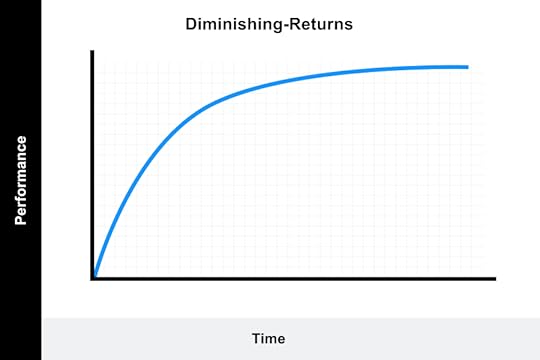
I'd even hazard to say that one can become at least a mediocre in a week's time without stressing too much about it. I got what he is trying to convey, to not waste energies on thing we have no competence, and he might be right there, but the reason he states as to why we shouldn't do that is totally wrong, since with or without the context, it's a child's play to become just mediocre. Whether we should put energy or not into that is different issue, besides it doesn't take that much energy just to become a mediocre level player in any field. Well, it might sound like a refrain, but general or otherwise, his reasoning is wrong, about why we shouldn't work on something we are not good at. It might be right that we need to avoid the areas we are absolutely dreadful at, if we can. But his reasoning is something I can't agree with.
Still a must read, since it makes us ask some important questions that would aid is in self-awareness.
View all my reviews


Comments
Post a Comment